
Loading...
Serving Columbia, MO and surrounding areas. (573) 530-1593
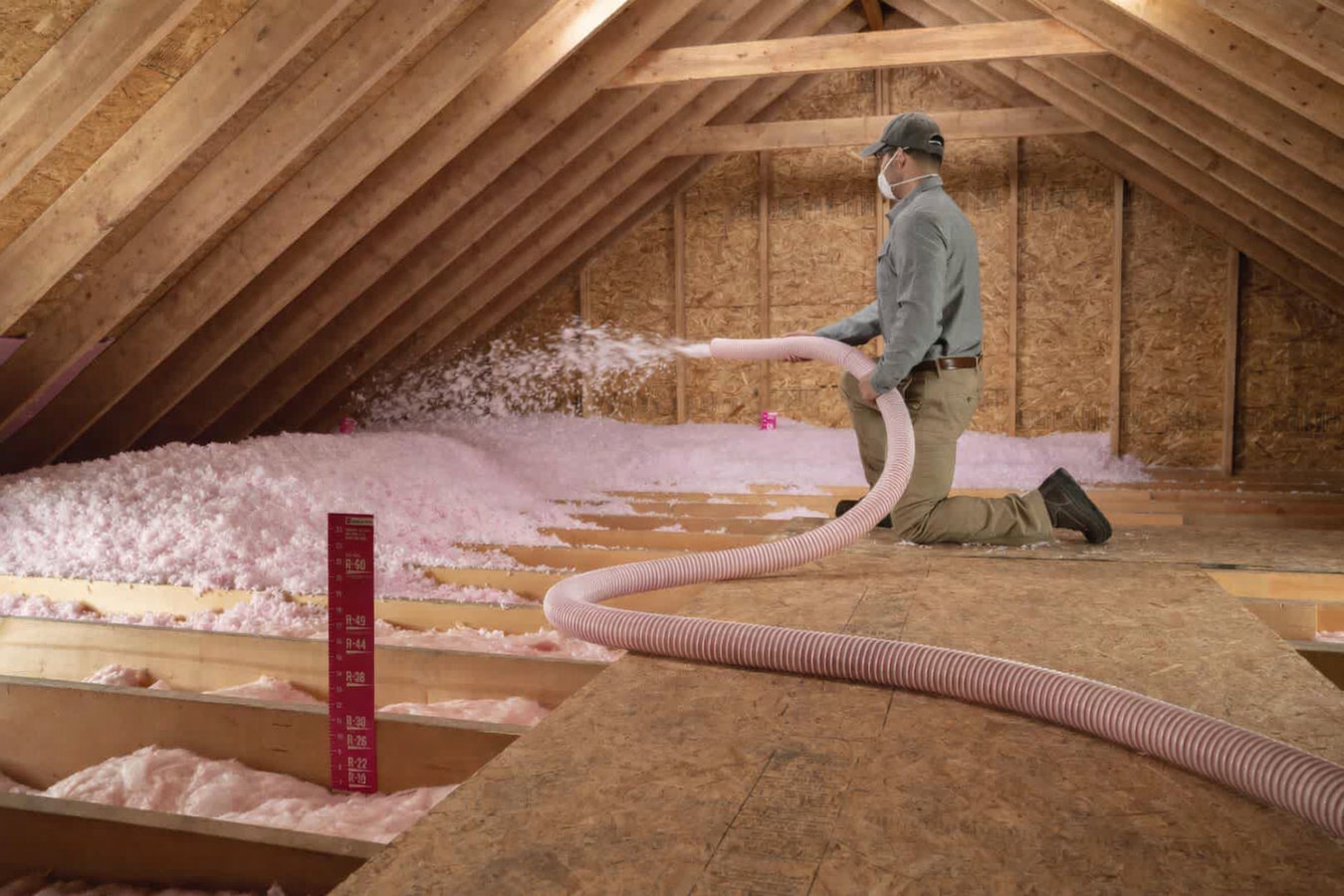
Columbia Insulation fills your attic to the right depth so your heating and cooling system stops fighting your house. Most jobs are finished in a single visit with no disruption to your day.
Blown-in insulation in Columbia, MO uses a truck-mounted machine to fill your attic with loose fiberglass or cellulose that settles around every pipe, wire, and corner batts miss. Most attic jobs are completed in a single day, often in just two to five hours.
A large share of Columbia homes were built in the 1950s through 1970s, when insulation standards were far less demanding than today. That original material has typically settled and compressed over the decades, leaving you with a fraction of the thermal resistance the attic needs. When your ceiling is the main escape route for heat in January and the main entry point in July, your furnace and air conditioner are doing extra work every single day.
Blown-in is often paired with attic insulation work that includes air sealing around light fixtures and plumbing penetrations before the material goes in. That combination consistently produces better results than insulation alone.
If your utility bills have risen over the past few winters without a clear explanation, your attic is one of the first places to investigate. Heat rises, and in a Columbia winter, an under-insulated attic can account for a significant share of your home's total heat loss. This pattern is especially common in older Columbia homes where the original insulation has settled and thinned over decades of use.
Look into your attic. If you can see the tops of the wooden framing members above the insulation, you almost certainly do not have enough coverage. Adequate insulation should bury those joists completely. This is one of the most reliable visual checks you can do yourself without tools, and it immediately tells you whether a contractor visit is warranted.
If your top-floor rooms feel like a different climate from the rest of the house, stuffy in July and chilly in January, that is a strong signal that your attic is not doing its job. In Columbia's climate, where summers are genuinely hot and winters reach the single digits, uneven temperatures room to room usually point to insulation gaps rather than HVAC problems.
Columbia has a substantial number of homes from the mid-20th century. Homes built before 1980 were constructed under very different energy standards. If the insulation has never been assessed, there is a good chance it is too thin, has settled significantly, or was installed with materials that have degraded. Homes in older Columbia neighborhoods near the University of Missouri campus are especially likely to be in this situation.
Columbia Insulation installs both fiberglass and cellulose blown-in insulation depending on your attic conditions, budget, and the specific performance goals for your home. Fiberglass blown-in holds its shape well in humid environments and resists moisture absorption, which makes it a reliable choice in Columbia's warm, damp summers. Cellulose is made from recycled paper treated for fire and pest resistance and settles around irregular framing with excellent coverage.
Before installing any material, we assess the existing insulation depth, check ventilation, and seal air gaps around light fixtures and plumbing penetrations. Air sealing is the step most contractors skip to save time, but it is the step that most affects how well the finished job actually performs. Our home insulation service covers the full building envelope if your project extends beyond the attic alone.
Every job includes depth markers placed in the finished insulation so you can verify coverage before we leave. We walk you through the completed work and explain what was done in plain terms before packing up.
Homes where moisture tolerance and long-term shape retention are the priority, particularly in Columbia's humid climate.
Homes where recycled content and excellent coverage around irregular framing and obstacles are the main goals.
Homes with some existing insulation that has settled or was never brought to the recommended depth for Missouri's climate zone.
Homes where gaps around fixtures, plumbing, and the tops of interior walls are letting conditioned air escape before insulation can slow heat transfer.
Columbia sits in what the U.S. Department of Energy classifies as Climate Zone 4, a mixed-humid zone with cold winters and hot, humid summers. That combination means your attic insulation is working hard year-round, not just in one season. Homes that fall short of the recommended R-value pay an energy penalty every single month.
Columbia grew substantially in the mid-20th century, and many neighborhoods near the University of Missouri campus, including Benton-Stephens and Old Southwest, contain homes from the 1920s through 1960s. Homes from that era were often built with little or no attic insulation by today's standards, or with materials that have compressed and degraded over time. Missouri's humidity also affects which insulation material performs best: cellulose can absorb moisture if attic ventilation is poor, which is why we assess airflow before recommending a material.
We serve Columbia and the surrounding mid-Missouri region. Homeowners in Fulton, Moberly, and Mexico face the same climate pressures and the same aging housing stock as Columbia. We bring the same assessment process and material standards to every job in the region.
Reach out by phone or the contact form. We respond within 1 business day and schedule an attic assessment at a time that works for you. You do not need to have all the answers ready.
We spend 20 to 30 minutes in your attic measuring existing insulation depth, checking ventilation, and identifying air leaks. You receive a written estimate that breaks out insulation, air sealing, and any prep work separately.
Clear a path to the attic hatch and make sure the crew can park near the house. The blowing machine runs through a long hose from the truck. You can stay home during the work, there is no need to leave.
The crew fills the attic to the agreed depth, paying close attention to edges and corners where heat loss is greatest. Before leaving, they place depth-marker rulers in the insulation so you can verify coverage yourself.
Free estimate. Written quote before we touch anything. No pressure, no obligation.
(573) 530-1593We place small ruler gauges in the finished insulation so you can verify the coverage depth yourself before we leave. A contractor who skips this step has no way to prove the job meets spec. We do not skip it.
We seal gaps around light fixtures, plumbing penetrations, and the tops of interior walls before blowing in any material. Insulation slows heat transfer; air sealing stops the drafts that make insulation perform far below its rated value. Most contractors skip this step to save time.
We serve Columbia and 11 surrounding communities from Jefferson City to Hannibal. Local contractors who know Columbia's housing stock and climate bring a level of context that out-of-town crews cannot match.
We assess your attic's ventilation and existing insulation before recommending fiberglass or cellulose. The North American Insulation Manufacturers Association recommends material selection based on site conditions, and that is exactly how we approach it.
These practices are not extras. They are the standard for a job that actually performs the way it is supposed to. When you call Columbia Insulation, you get a contractor who shows their work and stands behind the result.
For rebate eligibility, contact Columbia Water and Light before work begins to confirm current program details and any pre-approval requirements.
Blown-in is one part of a complete home insulation strategy. Learn how we address walls, floors, and the full building envelope.
Learn moreExplore our full attic insulation service, including air sealing and material selection tailored to your specific attic conditions.
Learn moreFall is our busiest season in Columbia. Lock in your date now and have your attic ready before the cold sets in.