
Loading...
Serving Columbia, MO and surrounding areas(573) 530-1593
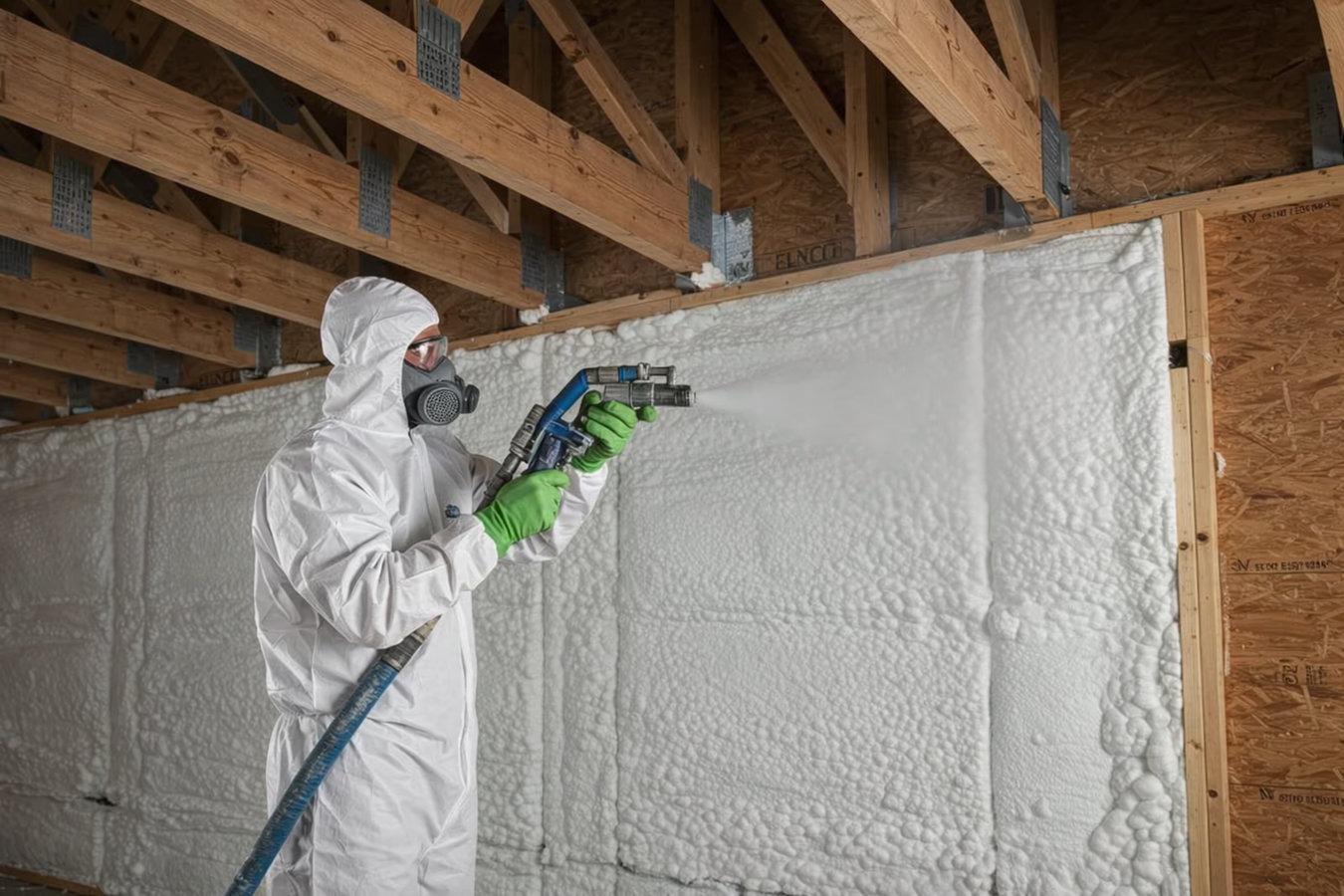
Columbia Insulation serves Lake St. Louis, MO with spray foam insulation, attic insulation, and air sealing for St. Charles County homeowners. We have completed insulation projects across the Missouri I-70 corridor since 2022, offering free on-site estimates with a guaranteed 1 business day response.
Every service below is available to Lake St. Louis homeowners and property managers. The linked card goes to the full service page.
Lake St. Louis homes built in the 1970s and 1980s during the original planned-community buildout often have uninsulated crawl spaces and rim joists — areas where closed-cell spray foam delivers the best combination of air sealing, moisture resistance, and R-value in a single application. St. Charles County's position along the Missouri River corridor brings high summer humidity that makes vapor management at the crawl space level particularly important.
Many Lake St. Louis homes from the 1980s and early 1990s carry R-19 to R-25 in the attic, installed to the energy standards of that era. Current IECC Climate Zone 4A guidance calls for R-49 in existing homes. Topping up to current levels with blown-in cellulose reduces the heat transfer that drives up cooling costs during St. Charles County summers and heating costs through Missouri winters.
Homes built in Lake St. Louis between 1975 and 1995 frequently have recessed light cans, dropped soffits, and plumbing chases that bypass the attic insulation entirely. Air sealing those penetrations before adding insulation is the step that converts a modest insulation upgrade into a measurable reduction in utility costs.
For Lake St. Louis homes in flood-adjacent areas near Lake St. Louis Boulevard or the I-70 corridor where storm water management is active, closed-cell foam in the crawl space and below-grade areas resists liquid water intrusion in a way that fiberglass batts cannot. It is also the preferred choice for homes that experience seasonal water table fluctuation in St. Charles County.
Western St. Charles County sits in a mixed-humid climate where crawl spaces without proper insulation and encapsulation allow ground moisture to migrate into floor framing year-round. Homes in Lake St. Louis with vented crawl spaces built to 1980s code are among the most common candidates for a full encapsulation upgrade.
A sealed vapor barrier is the first line of defense in any Lake St. Louis crawl space. The high humidity periods from June through September in St. Charles County drive ground moisture upward into unprotected floor joists, accelerating wood decay and creating the musty odors that homeowners near the lake often notice in finished lower levels.
Lake St. Louis was master-planned beginning in 1966 and formally incorporated in 1975, which means the bulk of the original residential development was built between the late 1960s and the early 1990s. That construction window predates the energy code revisions that drove insulation requirements upward in the 2000s and 2010s. A home built in 1978 to meet the energy standards of that year is operating roughly two to three code generations behind current IECC Climate Zone 4A requirements. That gap shows up on the utility bill every month.
The western St. Charles County location places Lake St. Louis in a section of Missouri that gets genuine winter cold and genuine summer humidity. January lows in St. Charles County routinely fall into the single digits during hard cold snaps, and July dew points above 65°F are the norm rather than the exception. A home built for the energy standards of the 1980s is working its heating and cooling equipment twice as hard as a properly insulated home during both extremes.
The community's median household income is well above the Missouri average, and homeowners in Lake St. Louis tend to own larger homes with more conditioned square footage — meaning the financial exposure from poor insulation is proportionally larger. A 2,800-square-foot home with inadequate attic insulation and an unencapsulated crawl space in western St. Charles County loses significantly more conditioned air per year than a smaller home with the same insulation deficiency.
Additionally, the distinction between homes "in the LSLCA" and those in newer non-CA developments means the housing stock is not uniform. Newer developments along the I-64 corridor built in the late 1990s and 2000s were constructed to better standards than the original planned-community homes, but still fall short of current R-value and air-tightness targets. Both segments benefit from targeted upgrades.
The homes we encounter most in Lake St. Louis are the original planned-community builds from the 1970s and early 1980s — properties with vented crawl spaces, original fiberglass batt insulation, and recessed lighting that bypasses the attic floor. These homes are well-maintained on the surface but often have never had the crawl space or attic boundary addressed in any meaningful way since original construction. Spray foam at the rim joist and crawl space walls combined with an attic air-seal and blown-in top-up is the project combination that produces the largest single-visit improvement for these homes.
Lake St. Louis sits between I-70 to the north and I-64 to the south in western St. Charles County, about 43 miles west of downtown St. Louis. We navigate Lake St. Louis Boulevard and the Hawk Ridge corridor regularly when scheduling visits on the south side of the city near The Meadows retail center. The National Equestrian Center on the city's eastern edge is a consistent landmark when coordinating jobs near that portion of the I-64 frontage. Permit questions for Lake St. Louis work go through the city's building department at lakesaintlouis.com rather than the county.
We also serve Fulton, MO and other communities along the I-70 corridor west of St. Louis, so Lake St. Louis fits naturally into our service routing rather than requiring a special trip.
Reach us at (573) 530-1593 or use the form on this page. We respond to Lake St. Louis inquiries within 1 business day to schedule a visit that fits your calendar.
A technician visits your home to inspect existing insulation depth, assess rim joist and crawl space conditions, and review attic access and bypass locations. The written estimate is itemized with no obligation — pricing is explained before any work begins.
Our crew arrives with all spray foam equipment. Crawl space and rim joist projects are typically complete in one day. Attic applications require adequate ventilation before the space is re-entered, and we confirm the re-occupancy timeline in writing before leaving.
Before we leave, we walk through the finished work, confirm foam depth and coverage, and provide written documentation for IRS Section 25C tax credit applications or any future permit or inspection records.
We respond to all Lake St. Louis estimate requests within 1 business day. The on-site visit is free and carries no obligation. We provide an itemized written quote covering materials, scope, and re-occupancy timeline so you have everything you need to make a decision at your own pace.
(573) 530-1593Lake St. Louis was conceived in the late 1960s by developer R.T. Crow as a master-planned lakefront community in western St. Charles County. The city incorporated in 1975 and is built around two private lakes — the 600-acre Lake St. Louis and the 85-acre Lake Ste. Louise — owned and managed by the Lake St. Louis Community Association for its members. The LSLCA operates beaches, a marina, pools, tennis and pickleball courts, and two par-3 golf courses as private amenities, giving the city a resort-community identity unlike any other municipality in the county.
The city spans 8.72 square miles positioned between I-70 to the north and I-64 to the south, about 43 miles west of downtown St. Louis. The 2020 Census counted 16,707 residents across roughly 6,500 households, with a median household income well above Missouri and national medians — a reflection of the owner-occupied, family-oriented demographic that the lake amenities and the Wentzville R-IV school district attract and retain. Wentzville R-IV is consistently described as the fastest-growing school district in Missouri, which reflects directly on the residential demand that keeps Lake St. Louis values strong.
The commercial identity of the city is anchored by The Meadows at Lake St. Louis, a lifestyle center along the I-64 corridor, alongside The Shoppes at Hawk Ridge and the National Equestrian Center on the city's eastern edge. The NEC operates three arenas and 585 horse stalls as a St. Charles County-operated regional venue. Homes outside the LSLCA boundaries access city parks including Founders Park Sports Complex and Veterans Memorial Park. We also serve homeowners across the broader I-70 corridor, including neighboring communities such as Warrensburg, MO further west.
Expands on contact to seal every gap and cavity, delivering a superior air barrier and high R-value in attics, walls, and crawl spaces.
Learn moreKeeps conditioned air inside your home by blanketing the attic floor with a deep, code-compliant layer of insulation.
Learn moreLoose-fill fiberglass or cellulose blown into attics and wall cavities for fast, uniform coverage with minimal disruption.
Learn moreWhole-home insulation assessment and installation covering every area of the building envelope from attic to basement.
Learn moreSafe extraction of old, damaged, or contaminated insulation before new material is installed for maximum performance.
Learn moreInsulates the floor system or encapsulates the crawl space to stop moisture, drafts, and heat loss from below.
Learn moreInjection foam and blown-in options fill existing wall cavities without requiring full demolition or siding removal.
Learn moreSeals penetrations, gaps, and bypasses throughout the building envelope to eliminate drafts and reduce energy waste.
Learn moreInsulates rim joists, foundation walls, and basement ceilings to control temperature and prevent moisture issues.
Learn moreDense, rigid spray foam that doubles as a vapor barrier with the highest R-value per inch of any insulation type.
Learn moreLightweight, flexible spray foam ideal for interior walls and attics where sound control and air sealing are priorities.
Learn moreSeals top-plates, penetrations, and bypasses in the attic before insulation is added for maximum thermal performance.
Learn moreHeavy-duty poly sheeting installed across the crawl space floor to block ground moisture and protect framing.
Learn moreProfessional installation of vapor retarders in walls, floors, and crawl spaces to manage moisture movement.
Learn moreUpgrades insulation in existing homes using low-disruption methods that improve comfort without full renovation.
Learn moreInsulation solutions for commercial buildings, warehouses, and light industrial spaces using code-compliant materials.
Learn moreServing these cities and communities.
Call (573) 530-1593 or submit the form above. We respond within 1 business day with a free, no-obligation on-site assessment for St. Charles County homeowners.